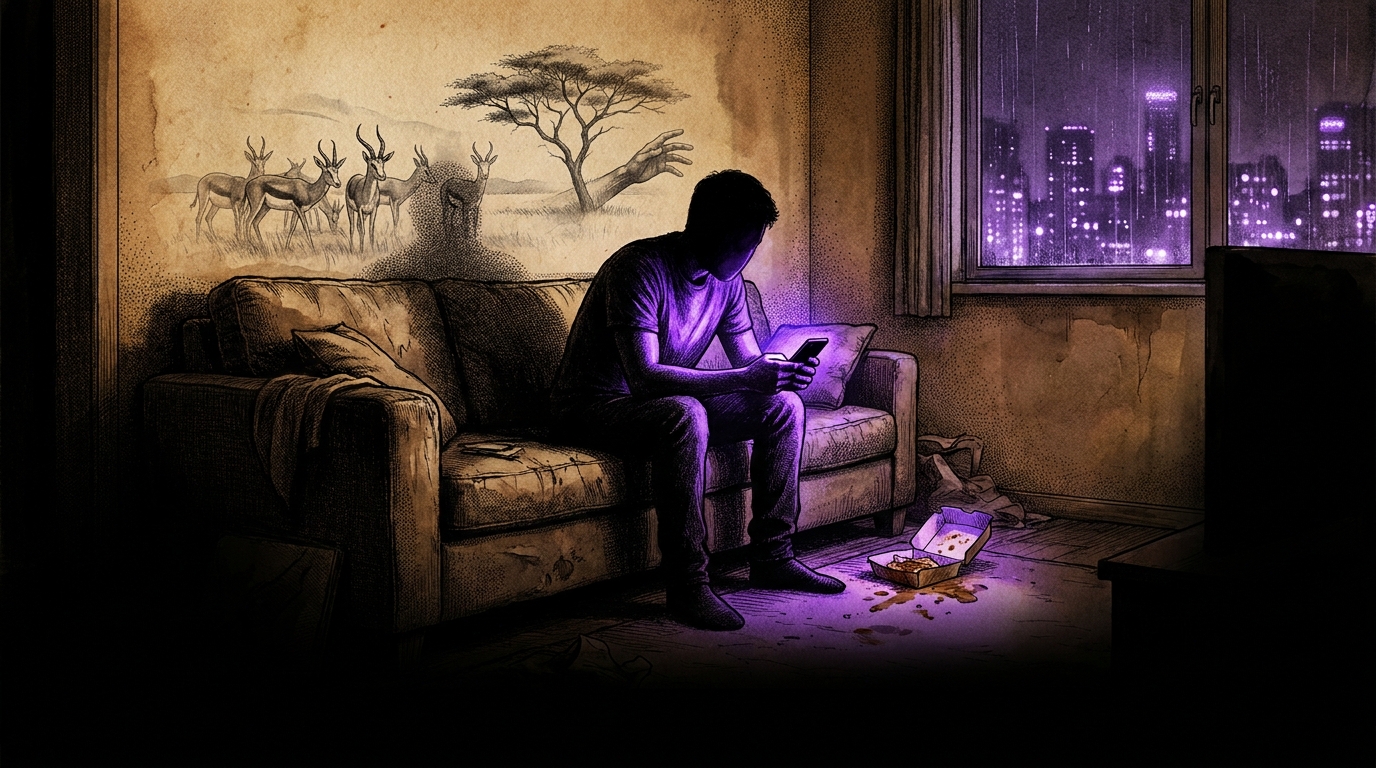
In the first two chapters, we saw nature spend several million years carefully designing a reward system tuned for high effort, high friction, and absolute scarcity. Then in the span of just a few decades, the same species built itself an alternate world of unlimited calories, unlimited information, and total physical comfort.
This is evolutionary mismatch. The business logic of modern life is, when you strip away the marketing, a systematic hack running against the four DOSE base routines. Capital and algorithms have located, with alarming precision, the cheat codes that bypass "survival effort" and trigger neurotransmitter release directly.
Let's go through it slowly. The four molecules that once kept us alive — and how each of them is, in this strange new environment, eating us.
IThe Dopamine Catastrophe — From Survival Drive to Cheap Super-Stimulus
In the ancestral environment, dopamine release had a natural "physical ceiling." You had to walk ten kilometers to find a single bush of sweet berries; dopamine paid you only enough to make the walk worthwhile. Modern life invented the ultimate weapon to defeat that ceiling: supernormal stimuli · 超常刺激 supernormal stimuli · 超常刺激
Coined by ethologist Niko Tinbergen: an artificially exaggerated trigger that hijacks an animal's instincts more effectively than the real thing. A seagull, given a fake egg with cartoonishly oversized red spots, will choose to incubate the fake egg over its own real ones. .
Hack OneFood mismatch — “sweet plus fat,” a combination that doesn't exist in nature
Nothing in nature is simultaneously high-sugar and high-fat. Either you're eating fruit (sugar) or you're eating meat (fat). The food industry invented the donut and the fried chicken. The instant you bite into a donut, your brain interprets it as an unbelievably rare, calorie-dense ancestral resource — enough to survive three winters. Dopamine erupts.
Hack TwoMating mismatch — “a thousand alphas” on a 6-inch screen
A Pleistocene human met a handful of potential mates in a lifetime. Today, a teenager opens a porn site, and the ancient circuit produces an absurd hallucination: "My God, I'm the top alpha of an enormous tribe — I have unlimited reproductive opportunities." Dopamine releases at nuclear levels.
Hack ThreeInformation mismatch — short-form video and the infinite scroll
Our ancestors needed to be exquisitely sensitive to novelty in their environment — a moving shadow could be a predator. TikTok's algorithm targets that exact circuit. Every swipe up is another round of reward-prediction-error roulette. Your brain thinks it's gathering survival-critical signals. Actually, you're watching a cat do a backflip.
IIThe Serotonin Collapse — Globalized Comparison and Learned Helplessness
Serotonin, you'll remember, is your brain's "social standing and safety" reading. In the ancestral world, your social context was capped at Dunbar's number — about 150 people.
HackSocial media as infinite-dimensional comparison
Inside a 150-person tribe, getting enough serotonin was relatively achievable. You might not be the fastest runner, but you might be the best at roasting meat, or the best storyteller. You only had to be valuable in some dimension and you had a place — and your serotonin stayed healthy.
Today, Instagram and Xiaohongshu and your friends-feed have shattered Dunbar's number. The serotonin meter in your brain is still doing its conscientious work, but what it's now scanning is no longer the people in the tent next door. It's:
- Founders ten years younger than you who are already worth nine figures.
- Fitness influencers with perfect abs vacationing across the globe.
- Parents in penthouse apartments raising children fluent in eight languages.
IIIThe Alienation of Oxytocin — Loneliness and Tribal War in the Digital Age
Oxytocin needs real physical touch, real eye contact, and shared survival challenges to release. It's the glue that turns sand into stone.
HackBodyless virtual connection
Modern life produces an illusion: we appear more connected than at any time in history (5,000 friends on WeChat) — and meanwhile our actual biological bodies are more isolated than ever before.
Texts, likes, and emoji can barely move oxytocin at all. The oxytocin system is ancient and it only recognizes "physical signals": the warmth of a hug, dilated pupils across a table, a shared smell at a meal. The modern human lives alone in a concrete cell, works through a screen, has dinner alone from a delivery app. We are living through a long, invisible oxytocin famine.
HackThe algorithm of hatred — virtual tribal warfare
Oxytocin starvation produces sustained loneliness and high cortisol. But the more sinister problem is oxytocin's dark side — the same molecule that bonds the in-group also fuels rejection of, and hatred toward, the out-group. Oxytocin is the chemistry of tribalism.
Internet algorithms exploit this with terrifying efficiency. Since real-life tribes are rare, the algorithm builds you a virtual one. The fastest way to manufacture in-group cohesion online is to manufacture a common enemy.
Fandom wars. Gender flame wars. Far-left versus far-right shouting matches. When you and a few thousand strangers you've never met are united in screaming at another group of strangers, your brain is releasing a thin, distorted form of oxytocin. It produces a pathological version of belonging — "these people online are my tribe; together we're holding off the enemy."
IVThe Withering of Endorphins — The Comfort Crisis and the Pit of Addiction
The base logic of endorphins is simple and unforgiving: no pain, no reward. They are the painkillers nature delivers only when the body is genuinely suffering.
HackThe complete elimination of physical discomfort
The crowning achievement of modern life is that physical pain and discomfort have been almost completely deleted:
- Too hot? Air conditioning.
- Tired legs? An Uber.
- Hungry? 24-hour food delivery.
- Slight headache? Ibuprofen on demand.
In 300,000 years of human history, our bodies have never been as comfortable, as physically unchallenged, as they have been in the past few decades.
ConsequenceHypersensitivity to mental pain — and the opioid crisis
When you stop putting your body through real physical challenge, the endorphin system atrophies — like any muscle that goes unused. That sets up a serious modern illness: our tolerance for pain has collapsed.
And because the body no longer experiences physical pain, all of modern stress is now psychological and chronic — mortgages, a manipulative boss, the pressure to get into a school. But psychological pain cannot be discharged by running an antelope to death! Faced with mental pain that has no physical outlet, the modern endorphin-starved brain reaches for two extremes:
Recap — The most healing chicken soup for the soul
That's the autopsy. So now do you understand why "evolutionary theory is the best chicken soup for the soul"?
When you can't drag yourself out of bed in the morning and feel guilty for spending the day on short videos —
when your hands sweat in a crowd and you decide you must be a freak —
when you see somebody else's perfect life online and the depression and inferiority sink in —
please stop, take a long breath, and forgive yourself.
You are not sick. There is nothing wrong with your personality. Your willpower is not weaker than anyone else's. You are running an extraordinarily refined, battle-tested top-tier survival brain — built for the African savanna — and someone has dropped you into a neurotransmitter slaughterhouse made of capital, algorithms, super-stimuli, and digital pseudo-socializing.
Your depression, your anxiety, your social phobia — those are not flaws. They are your magnificent ancestral genome doing everything it can to keep you alive in an environment that wasn't supposed to exist.
Knowing you're not broken is just the first step, though. As humans with self-awareness, we can do more than be passively reshaped by algorithms and environments. If we can reverse-engineer this system, we can build, inside the modern world, an entirely new way to live. That is the subject of the next chapter: Engineering our Happiness.