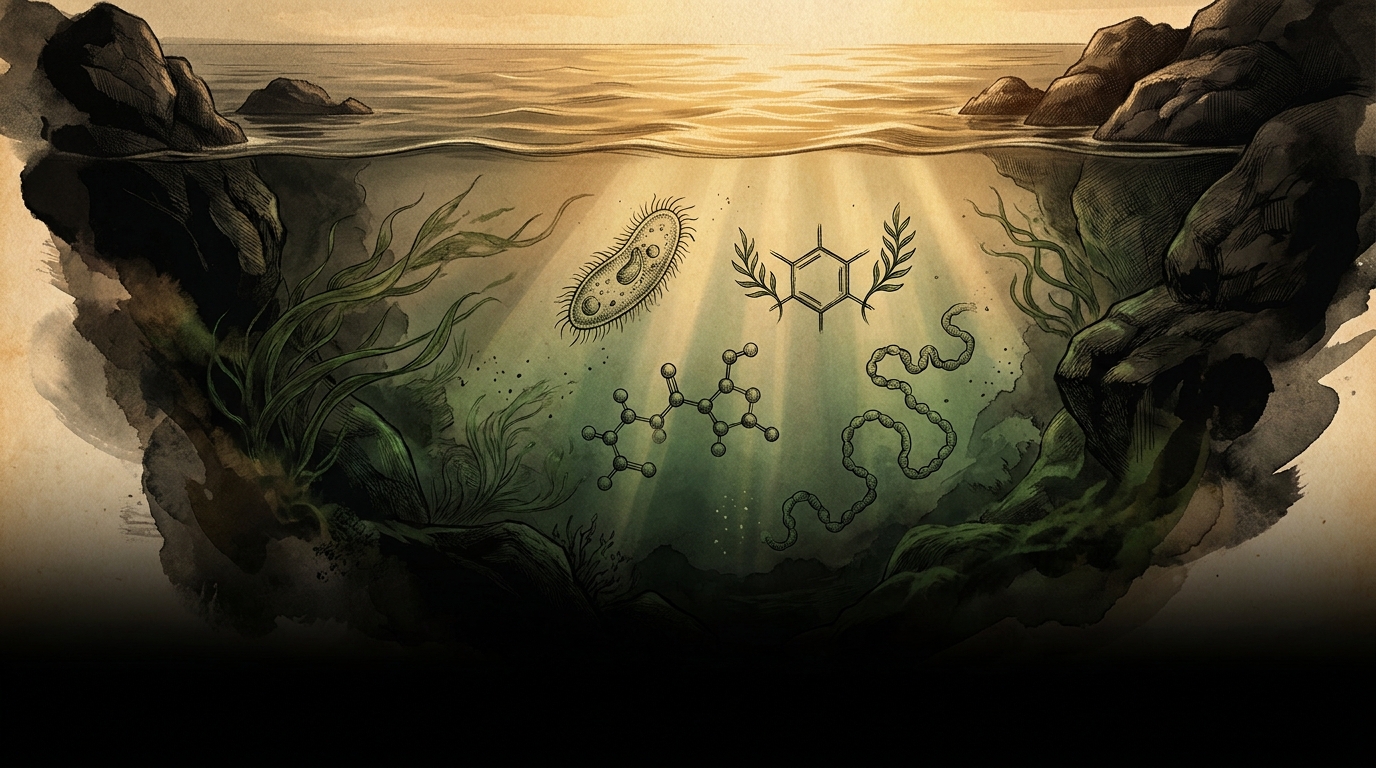
If you imagine the evolution of life on Earth as one long epic poem, the four DOSE neurotransmitters appear in a strict order: first comes a molecule that knows whether food is around (serotonin), then one that pushes the body to go get it (dopamine), then a painkiller for the inevitable injuries that follow (endorphins), and finally — much, much later — a molecule that glues mothers to babies and tribes together (oxytocin).
DOSE was not invented to make you happy. In the long story of evolution, "happy" was just the carrot nature offered so you would stay alive and reproduce; pain was the stick. To engineer our happiness — to design our own emotional lives like an engineer reading the commit history of an ancient codebase — we have to go back and read the original commits for these four molecules.
Hold this premise in mind: nature is a stingy, pragmatic programmer. She does not care whether you feel good. She cares whether you survive and reproduce. The DOSE quartet is not a happiness toolkit; it's a series of patches she shipped over several billion years, each one solving a specific survival crisis at a specific moment in time.
In the order they appeared, that's:
Serotonin · 血清素 Serotonin · 血清素
The oldest of the four. A tryptophan metabolite already used by single-celled organisms long before nervous systems existed. >
Dopamine · 多巴胺 Dopamine · 多巴胺
A tyrosine metabolite. In its earliest form, it just controlled movement in primitive animals; later evolution wired it to the anticipation of reward. >
Endorphins · 内啡肽 Endorphins · 内啡肽
Endogenous opioid peptides. Evolved in vertebrates to override unbearable pain so an injured animal could still escape. >
Oxytocin · 催产素 Oxytocin · 催产素
A mammal-only neuropeptide, descended from a fish hormone called vasotocin. The chemistry behind maternal bonds, pair bonds, and tribal trust. .
ISerotonin — The Ancient Resource & Status Meter
OriginThe single-cell dinner problem
Serotonin is the oldest molecule in DOSE. Long before there were multi-celled organisms — when life on Earth still looked like pond scum — paramecia, amoebae, and even plants (bananas and walnuts contain a surprising amount of serotonin) and fungi were already using it.
The earliest forms of life faced one fundamental question: are there nutrients around me right now? Should I divide and reproduce, or hunker down and conserve energy? Serotonin started life as a pure metabolic-and-environmental signal. When food was abundant in the surrounding water, single-celled organisms synthesized serotonin and started dividing. When resources ran out, serotonin dropped and the cell powered down.
UpgradeFrom “food nearby” to “rank and safety”
Once multi-celled animals and nervous systems came along, nature didn't bother inventing a new molecule. She just took serotonin and gave it a new job description.
In arthropods like the famously studied lobster · 龙虾实验 lobster · 龙虾实验
A classic case in neuroscience: a lobster that wins a territorial fight gets a serotonin surge and stretches its body out into a confident posture; a lobster that loses gets a serotonin crash and curls up. Jordan Peterson popularized this as a metaphor for human social hierarchy in 12 Rules for Life. , serotonin was repurposed into a status sensor.
Lobsters fight. They fight over the best hiding spots and the best mates, and there is only so much of either to go around. When a lobster wins a fight, its brain floods with serotonin: nerves get excitable, the body unfurls, the claws come up. It looks like a king — not just to scare off rivals, but to tell itself: I have territory, I am safe, the resources are mine.
When a lobster loses, serotonin drops and a different molecule called octopamine takes over. The lobster shrinks down, becomes hyper-vigilant, and bolts at the slightest disturbance.
IIDopamine — The Wanting Engine
OriginSo that things could move
Plants don't need dopamine. Plants are rooted, and the food comes to them. Animals are different: an animal has to actively go out and find food and mates.
In the absurdly simple nematode — a worm with only 302 neurons — dopamine has just one job: locomotion. The nematode smells bacteria (food), dopamine releases, its muscles contract, and it crawls toward the smell. When that system fails in modern humans — as it does in Parkinson's disease — we get exactly what you'd expect: stiff, halting, frozen movement. The "engine oil" for the chassis is gone.
UpgradeFrom movement to the Reward Prediction Error
Nature loves a side-effect. Since dopamine was already responsible for getting you to move toward food, why not bolt the anticipation of food onto the same circuit? That move gave us one of the most important findings in modern neuroscience: Reward Prediction Error · 奖励预测误差 Reward Prediction Error · 奖励预测误差
Proposed by Wolfram Schultz in the 1990s, based on monkey electrophysiology experiments. Dopamine neurons fire not when the reward arrives, but the moment a cue predicts the reward is coming. The theory rewrote our understanding of motivation and addiction. theory, proposed by Wolfram Schultz.
Dopamine is not pleasure. Dopamine is wanting. It is the carrot evolution dangles permanently in front of you, and the trick is that you never quite reach it — what matters isn't getting the thing, it's expecting to get it. This is the chemical that drove our ancestors out of Africa, across glaciers, into entirely new continents. Whatever was over the next ridge, dopamine was whispering: maybe more.
IIIEndorphins — The Painkiller for Life-or-Death
OriginAgainst paralyzing pain
As life evolved more complex nervous systems, pain became a sharper, more accurate alarm — and a double-edged sword. Pain is necessary: it tells you get away from the fire, don't put weight on that broken leg.
But picture this. A primitive amphibian is running from a predator, and the predator gets a piece of it. If pain takes over now, the amphibian collapses to the ground writhing, and the predator finishes the job. To patch this fatal bug, nature evolved the endogenous opioid system.
Endorphins are chemically almost indistinguishable from poppy-derived morphine. They bind the same μ-opioid receptors in your central nervous system, and they brutally cut off the pain signal before it ever reaches your cortex.
UpgradeThe reward beyond your physical limits
Endorphins have a very high release threshold. They are an emergency system. They fire only when the body is genuinely tearing — extreme exhaustion, grave stress, severe oxygen debt. Out in the wild, a zebra slashed open by a lion can sprint for kilometers feeling almost nothing; the pain only catches up once it has reached safety and the endorphins fade.
Then evolution noticed something. The blissful calm after the painkilling could itself be used as a reward — to push an animal through massive exhaustion when the survival situation demanded it (long migrations, weeks-long hunts).
IVOxytocin — The Glue of Mammals
OriginNegligent reptiles vs. helpless mammal babies
Before mammals existed, reptiles (dinosaurs, crocodiles, sea turtles) had a simple reproductive strategy: lay a clutch of eggs, bury them in the sand, and walk away. Whatever hatches, hatches.
Mammals changed the deal. Mammals do live birth. That meant a mother had to carry an embryo internally for months, then deliver something so fragile it can't even hold its own head up. Which posed a serious evolutionary question: why would a mother turn her own precious calories into milk for this helpless lump of flesh? Why wouldn't she, in a hungry winter, simply eat it?
Nature's solution was to take an old hormone — vasotocin, used by fish and reptiles to regulate water balance — and remix it. Out came oxytocin. Its first job was purely physical: trigger uterine contractions during birth (squeezing the baby out) and stimulate milk letdown when the baby suckles.
UpgradeFrom milking to selfless love
Then came one of the most romantic “hacks” in the entire history of the brain. Nature took this hormone — the one that controlled the uterus and the mammary glands — and wired it into the emotional circuits of the brain itself, including the amygdala and the reward system.
When a mother nurses her baby now, oxytocin doesn't just empty her breasts; it floods her brain. It powerfully suppresses the amygdala's fear-and-flee response, and it lights up reward. It writes a piece of code into her: “Protecting and feeding this fragile creature is more important than your own life — and you will feel happier doing it than doing almost anything else.” This is the chemical machinery underneath what we call maternal attachment.
As evolution kept moving — through primates, into humans — oxytocin escaped the mother-infant dyad:
- Pair bonds: Oxytocin released during sex (especially after orgasm) makes both partners trust and attach to each other. It pushes them to stay together and co-parent — because human babies are absurdly difficult to raise, and a single mother in the Pleistocene rarely survived.
- Tribal alliances: Mutual grooming, dancing around a fire, sharing food — all of these trigger oxytocin. They're how a physically weak species like ours managed to fuse 150 selfish individuals into something that could fight off saber-toothed cats and survive ice ages: not by being stronger, but by trusting each other.
Recap — An ancient survival computer
With those four lines of base code in place, nature had assembled a small but capable survival computer:
- Serotonin reads the environment and tells you: "There's enough here. Your standing is fine. No need to panic." — the baseline of survival.
- Dopamine sets goals: "There's a fruit tree over the next ridge — go." — the drive to acquire resources.
- Endorphins override damage: "Your foot is bleeding, don't stop, keep running." — the shield for getting through hard things.
- Oxytocin builds bonds: "Share the fruit with the tribe and your kids — next time you're hurt, they'll have your back." — the insurance policy of group survival.
For several million years, this exquisitely tuned operating system ran perfectly inside the skulls of australopithecines, then Homo erectus, then Homo sapiens. And then, in a span of just a few hundred years, the species that grew up in this software did something nobody anticipated: it built itself a brand-new piece of hardware called "modern industrial / information society" — and force-installed the same Stone Age OS inside it.
Next chapter, we go back to the African savanna where this brain was actually shaped. Out there in a world of high friction, scarcity, and constant danger, watch how DOSE quietly choreographed an entire day of survival — and got our naked-ape ancestors all the way through the Ice Age in one piece.