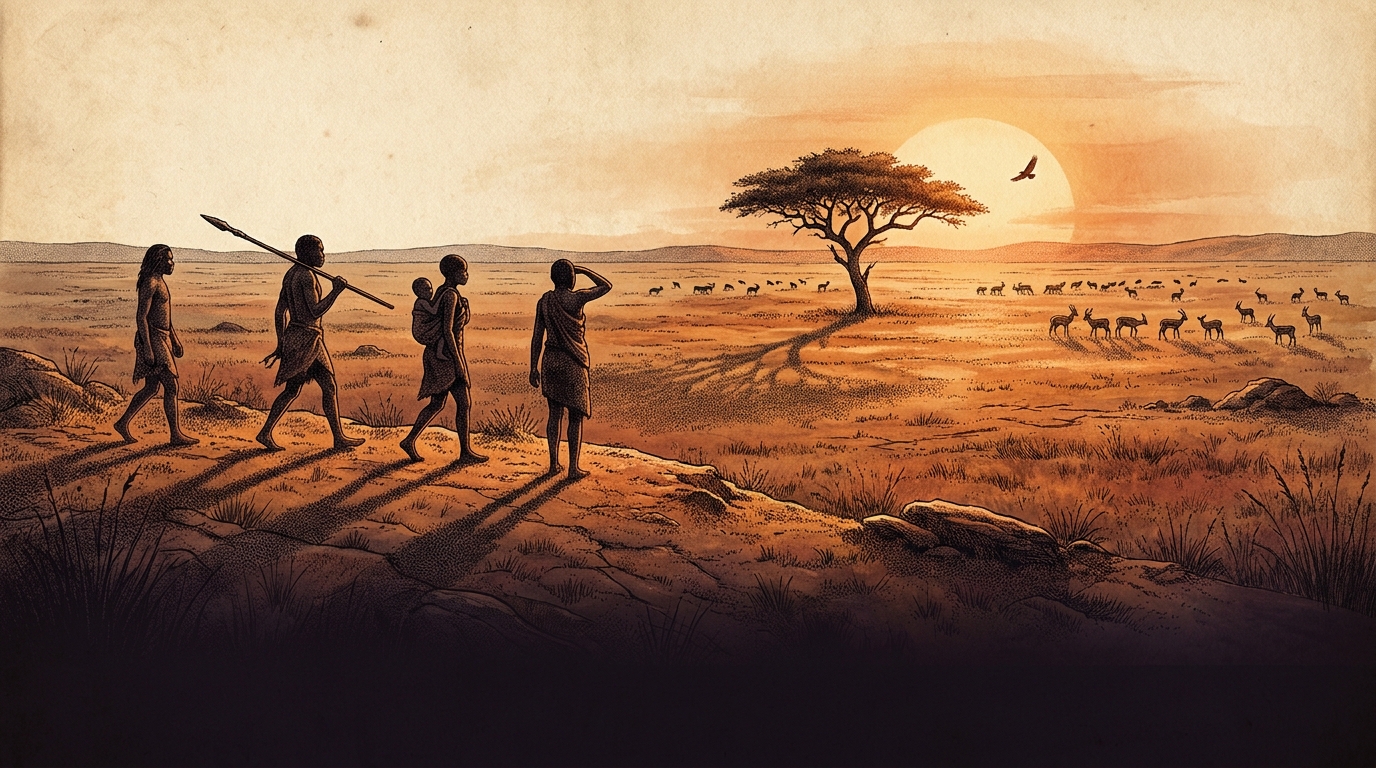
Evolutionary biology has a concept called EEA — the Environment of Evolutionary Adaptedness. So how did we — the "naked apes" with no fangs, no claws, and no thick fur — make it through the Pleistocene? The answer is that DOSE, working as a single tightly coupled system inside the brains of our ancestors, formed a flawless closed-loop survival protocol.
Roll the clock back to roughly 300,000 to 10,000 years ago — the long, slow Pleistocene, the hunter-gatherer epoch. In that brutal world, every drop of every neurotransmitter cost something, and every release was tied directly to staying alive. Nature held the valves with surgical tightness. No molecule was wasted.
Let's drop these four chemicals into a single day in the life of a Pleistocene human and watch the whole system run.
IDopamine — The Resource Tracker and Exploration Engine
In the world our brains evolved for, calorie-dense food (sugar, fat) was extraordinarily rare. Miss your high-calorie find today and you might starve tomorrow.
Use OneVision-triggered foraging drive
Imagine an early human walking through a forest. A patch of red flashes between the green leaves — possibly ripe berries. That's the first dopamine spike of the day.
Dopamine is not the reward for eating. It's the chemical injection that says: "Lock onto that red. Walk over there. Push through the thorns and grab it." Without dopamine, our ancestor might have thought, "ugh, too tired, even if that's food I can't be bothered." That gene was deleted from the gene pool a long time ago.
Use TwoLong-range tracking and the management of expectation
Hunting wasn't a lucky accident. When a hunter spotted antelope hoofprints in the dirt or caught the smell of fresh dung, dopamine kept releasing in a slow, sustained pattern. We now call this "the continuous feedback of reward prediction error." Every new clue — a drop of blood, a snapped twig — gives the brain a small dopamine bump, and that's what kept attention and motivation locked in for days.
Use ThreeThe “wanderer gene” that walked us out of Africa
Modern genetics has found a variant of the dopamine receptor gene — DRD4-7R · “the wanderer gene” DRD4-7R · “the wanderer gene”
The 7-Repeat variant of the DRD4 gene. It is significantly more common in nomadic groups and the descendants of long-distance migrants. The receptor reacts more weakly to dopamine, so carriers crave novelty and stimulation more intensely. — sometimes called "the wanderer gene" or "the explorer gene."
Dopamine doesn't only push you toward food. It pushes you toward the unknown. Why didn't Homo sapiens stay safely in Africa? Why did we cross glaciers and reach the Americas? Because dopamine was always whispering: "There might be more on the other side of the mountain."
IIEndorphins — The Shield of Persistence Hunting
Humans are one of the rare animals capable of persistence hunting · 耐力狩猎 persistence hunting · 耐力狩猎
Our ancestors used two superpowers — efficient bipedal walking and a body covered in sweat glands — to chase large animals during the hottest part of the day until those animals literally collapsed from heatstroke. The San hunters of the Kalahari still do it today. .
We can't outrun a cheetah. But humans have two superpowers: upright walking (extremely efficient) and a body covered in sweat glands with no fur (a cooling system unmatched in the animal kingdom). Our hunting strategy was, frankly, brutal: in the heat of the day, you chase a large animal — antelope, zebra — and you don't let it stop. You don't have to be faster. You just have to keep going. Eventually, with no way to dump heat, the animal collapses.
Life or deathSuppressing the tearing pain of the body
A persistence hunt typically meant running for four to eight hours in 40°C (104°F) heat. Blistered feet bursting open. Muscle fibers tearing. Joints screaming. Lungs burning.
Without endorphins, no human would last past the first hour. The pain alone would end the chase. But at the very edge of physical limits, the brain's opioid receptors light up: endorphins flood out like a tidal wave and cut off the pain signal between spinal cord and cortex. The hunter stops feeling the pain. Instead, a strange clarity takes over — what we now call the runner's high.
IIIOxytocin — Alloparenting and the Birth of the Super-Tribe
Evolution handed humans a near-fatal bug, and biologists call it the obstetric dilemma · 产科两难 obstetric dilemma · 产科两难
Humans need a narrow pelvis for upright walking, and a large skull for a smart brain. The two cannot be optimized simultaneously. Evolution's compromise was to deliver human babies in an extraordinarily underdeveloped state, then make up the difference with an extremely long childhood. .
For upright walking, women's pelvises had to narrow. For higher intelligence, human babies needed bigger skulls. If we let human infants finish developing in the womb, mothers would die in childbirth. Nature compromised: human babies are born ridiculously premature — they can't even hold up their own heads — and the rest of the maturation has to happen out in the world.
Use OneAlloparenting — the village raises the child
A Pleistocene mother could not single-handedly hunt, gather, and raise this needy creature. Humans have always relied on "the strength of the whole village" to raise children.
Oxytocin scaled up to meet this need. It stopped being purely a mother-infant chemical. It became a broad chemical resonance across the human group. When other women in the tribe — grandmothers, aunts — picked up the baby, or even just saw its round face and big eyes, their brains released oxytocin too, and they were biologically motivated to give their food to a child that wasn't theirs.
Use TwoBuilding a “super-organism” of life-or-death allies
In the Ice Age, going it alone meant dying. Early humans bound themselves to each other with a series of "oxytocin rituals":
- Sharing food around a fire — communal eating is one of the strongest oxytocin triggers we have.
- Synchronized physical movement — dancing together, singing together, chanting together.
- Mutual grooming — direct, deliberate physical touch.
Oxytocin lowered the natural wariness between human individuals (it suppresses the amygdala's fear response) and built unconditional trust where you'd otherwise expect suspicion. It turned 150 inherently selfish individuals into a single organism. When a saber-toothed cat appeared, an oxytocin-bound tribe would charge as a unit to defend each other — behavior that, from a strict survival-of-the-individual perspective, makes no sense at all.
IVSerotonin — The Invisible Stabilizer of Tribal Order
Once humans formed complex tribes of around 150 people ( Dunbar's number · 邓巴数 Dunbar's number · 邓巴数
Proposed by British anthropologist Robin Dunbar: limited by the size of the neocortex, the upper bound on stable social relationships a human can maintain is roughly 150. The number lines up uncannily with the size of ancestral hunter-gatherer bands — and explains why your WeChat friends list starts feeling impossible past 150. ), a different kind of crisis appeared. If everyone fights for the best meat and the best mate, won't the tribe just kill itself from the inside?
If they did, the tribe would have collapsed. Nature needed a non-violent mechanism to maintain order. Serotonin took the job.
UseA non-violent social hierarchy
Inside a tribe, serotonin acted as each person's internal “social-status dashboard.”
For an alpha — the chief, the best hunter — when he came back with meat and shared it, the tribe looked at him with reverence and gratitude. The brain registered that visual and auditory feedback as social approval and serotonin climbed steadily. High serotonin made him calm, confident, and generous. He didn't have to keep beating people up to prove anything; he just stood there and the order held.
For a marginal member — beta or below — when he failed, was sidelined, or got intimidated by the alpha, his serotonin crashed. He felt anxious and small. That feeling pushed him to bow his head, defer, give up his share of food.
Recap — A perfect day, drawn over and over for 300,000 years
Drop the four molecules into a single day in the life of an early human, and watch the protocol execute:
At dawn, the sun rises. Light hits the retina and wakes serotonin. The hunter feels calm and grounded. He is respected by his tribe; he feels safe.
Hunger sharpens, the craving for fat and meat builds, and dopamine spikes. The hunters take up their spears and walk excitedly into the unknown forest.
Five hours of tracking and running. Muscles tearing, lungs burning. Endorphins flood in, mask the pain, and carry the body through the final, fatal throw of the spear.
Sunset. The hunters carry the kill back to the cave. Everyone gathers around the fire — roasting meat, telling the day's stories. Skin against skin, warm light, shared food: oxytocin rises across every brain in the circle. They fall asleep wrapped in deep safety and deep belonging.
Notice what's happening. For 300,000 years, nature only released these four precious molecules after a real, demanding, survival-relevant physical act had been completed. And the system was self-balancing (homeostasis): dopamine that rises must come back down; pain that endorphins held off must eventually be felt. Every peak had its valley. The whole thing — built on scarcity and high friction — ran flawlessly century after century.
Until — just a couple of centuries ago — the Industrial Revolution and then the information revolution dropped onto our heads. Suddenly humans had cheat codes. We didn't need to hunt, we didn't need to build a real tribe, we didn't need to suffer to receive the chemicals. We could plug a cable straight into the brain and force these molecules to release on demand.
That is the source of modern anxiety, social phobia, and depression — the phenomenon biologists call "evolutionary mismatch." Next chapter: a clinical look at the systematic hack being run on your brain right now.